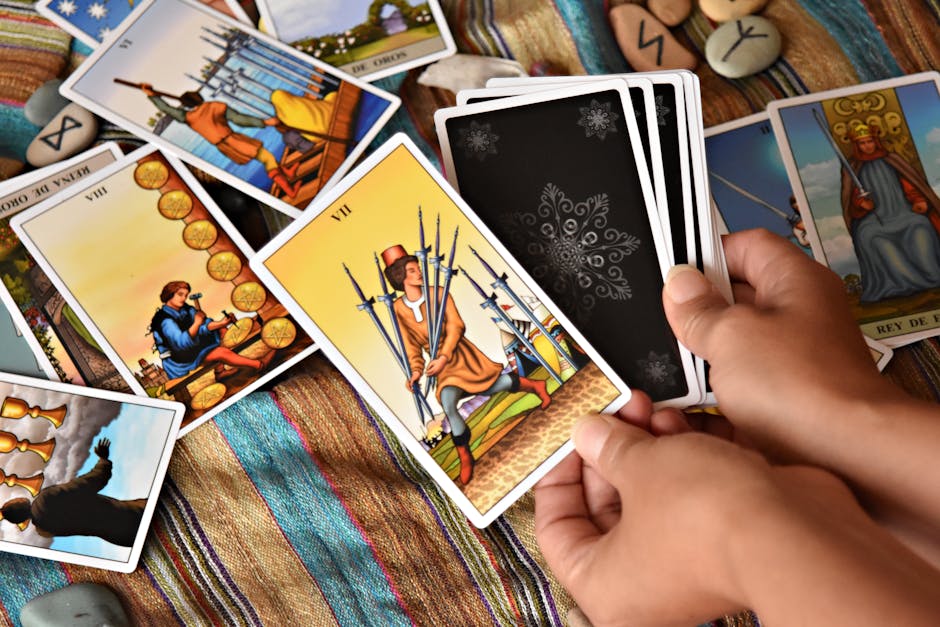
Tarot vs Oracle: Quick Comparison
Walk into any metaphysical shop or browse any online card retailer and you will find two broad categories dominating the shelves: tarot decks and oracle decks. They look similar at first glance — illustrated cards used for divination, self-reflection, and spiritual guidance. But the similarities are mostly surface-level.
✨ Quick Summary: Tarot and oracle cards compared across structure, reading style, learning curve, and best use cases — plus three methods for combining both systems in a single reading.
Tarot and oracle cards differ in structure, reading technique, learning requirements, and the type of insight they deliver. Understanding those differences helps you choose the right tool for your practice instead of buying a deck that frustrates you or sits unused.
Tarot Cards: The Structured System
Tarot follows a fixed architecture that has remained largely consistent since the 15th century. Every standard tarot deck contains exactly 78 cards divided into two sections:
The Major Arcana consists of 22 cards numbered 0 through 21. These represent major life themes, spiritual lessons, and significant turning points. Cards like The Fool (0), The Tower (16), and The World (21) carry archetypal weight — they point to forces and experiences that shape your life at a fundamental level.
The Minor Arcana contains 56 cards organized into four suits: Wands, Cups, Swords, and Pentacles (sometimes called Coins or Discs). Each suit runs from Ace through 10, followed by four court cards — Page, Knight, Queen, and King. The suits correspond to elements (fire, water, air, earth) and life domains (passion and career, emotions and relationships, intellect and conflict, material and financial matters).
This structure means every tarot deck shares a common language. If you learn the Rider-Waite system, you can pick up any standard tarot deck and read it, because the underlying framework of 78 cards, four suits, and Major/Minor divisions remains the same.
How Tarot Readings Work
Tarot readings typically use positional spreads — layouts where each card position has a designated meaning. The classic Celtic Cross spread, for example, assigns ten positions covering the present situation, challenges, subconscious influences, the recent past, possible outcomes, and more. The reader interprets each card in the context of its position, its relationships to neighboring cards, and the querent’s question.
This positional structure allows tarot to dissect complex situations with precision. A single spread can reveal the root cause of a problem, the querent’s blind spots, outside influences, likely outcomes if the current path continues, and advice for a different approach — all in one reading.
Popular Tarot Decks
- Rider-Waite-Smith (1909) — The foundational modern tarot deck. Its illustrated pip cards (Minor Arcana cards with scenic imagery rather than just suit symbols) revolutionized tarot reading and became the basis for most contemporary decks. This is the deck most guidebooks and courses reference.
- Thoth Tarot (1969) — Designed by Aleister Crowley with artwork by Lady Frieda Harris. It integrates astrology, Kabbalah, and ceremonial magic more heavily than the Rider-Waite system. The imagery is dense and symbolic, appealing to readers who want deep esoteric layers.
- Marseille Tarot — A family of decks originating in 17th-century France with unillustrated pip cards (the Three of Cups simply shows three cups rather than a scene). Reading Marseille requires stronger knowledge of numerology and suit theory since the imagery provides fewer narrative cues.
Oracle Cards: The Intuitive Approach
Oracle decks have no fixed structure, no universal card count, and no standardized system. A deck might contain 36 cards, 44 cards, 52 cards, or any other number the creator chooses. There are no suits, no Major or Minor divisions, and no positional hierarchy among the cards.
Each oracle deck is a self-contained world designed by its creator around a specific theme. One deck might focus on spirit animals, another on lunar phases, a third on angelic messages, and a fourth on affirmations for self-love. The guidebook that accompanies each deck provides the meanings, since there is no external system to reference.
This freedom means oracle decks can address virtually any niche. You can find oracle decks built around crystals, chakras, sacred geometry, plant medicine, mythological pantheons, shadow work, seasonal cycles, and dozens of other themes.
How Oracle Readings Work
Oracle readings lean heavily on intuitive pulls rather than positional spreads. The most common approach is to shuffle the deck while focusing on a question or intention, then draw one to three cards. The reader interprets the cards based on the guidebook meaning, the artwork’s visual impression, and their own intuitive response.
Some oracle decks include suggested spreads in their guidebooks, but these tend to be simpler than tarot layouts — often three-card arrangements like past/present/future or situation/advice/outcome. The emphasis is on receiving a message or theme rather than mapping out a detailed situation.
Oracle cards often deliver their guidance as affirmations, themes, or single-word concepts. You might pull a card that says “Surrender” or “Trust the Process” or “Boundaries.” The interpretation is less about decoding layered symbolism and more about sitting with a message and asking how it applies to your current circumstances.
Popular Oracle Decks
- Work Your Light Oracle (Rebecca Campbell, 2018) — 44 cards focused on soul mission, spiritual growth, and lightwork. The artwork is ethereal and luminous. Popular among readers who use oracle cards for daily inspiration and spiritual alignment.
- Spirit Animal Oracle (Colette Baron-Reid, 2018) — 68 cards featuring animal guides with messages about instincts, natural wisdom, and life navigation. Each animal carries specific guidance tied to its characteristics and cultural symbolism.
- Moonology Oracle (Yasmin Boland, 2018) — 44 cards organized around lunar phases and astrological connections. Designed for readers who time their practices with the moon cycle. Each card ties a lunar phase to practical guidance.
Head-to-Head Comparison
| Dimension | Tarot | Oracle |
|---|---|---|
| Deck size | Always 78 cards | Varies (typically 36-68 cards) |
| Structure | Fixed: 22 Major Arcana + 56 Minor Arcana in 4 suits | No fixed structure; creator-defined |
| Symbolism system | Standardized (Rider-Waite tradition is the baseline) | Unique to each deck; artist and theme driven |
| Learning curve | Steep — requires memorizing card meanings, suit associations, numerology, and spread positions | Gentle — guidebook-dependent, intuition-based |
| Reading style | Positional spreads (Celtic Cross, 3-card, 5-card, etc.) | Intuitive pulls, simple 1-3 card draws |
| Answer specificity | Highly specific — can address who, what, when, why, and how | Broad themes, affirmations, and directional guidance |
| Reversals | Most readers interpret reversed (upside-down) cards as modified or blocked energy | Reversals are uncommon; most oracle systems ignore card orientation |
| Transferable skill | Learn one deck, read any standard tarot deck | Each deck requires learning its own system from scratch |
| Best for | Detailed situation analysis, identifying root causes, timeline questions | Daily inspiration, emotional check-ins, spiritual themes |
| Customization | Limited by the fixed 78-card structure | Unlimited — decks exist for nearly every interest and spiritual path |
📌 Key Point: Oracle cards are not “tarot for beginners.” They are a different tool with different strengths. The choice is about preference and purpose, not skill level.
The Learning Curve in Detail
Tarot’s Investment
Learning tarot is a genuine study. A new reader needs to internalize the meanings of 78 individual cards, understand how those meanings shift based on position in a spread, recognize how neighboring cards modify each other’s messages, grasp the elemental associations of each suit, and develop fluency with at least two or three common spread layouts.
Most dedicated beginners spend three to six months before they feel confident reading for others. The payoff for this investment is significant — a skilled tarot reader can provide remarkably detailed and nuanced guidance that addresses specific aspects of any situation.
The structured nature of tarot also means there are abundant learning resources. Thousands of books, courses, YouTube channels, and communities teach the Rider-Waite system specifically, so you are never without guidance as you learn.
Oracle’s Accessibility
Oracle cards are designed to be usable on day one. You open the deck, read the guidebook entry for each card, and start pulling. There is no system to memorize because each deck is self-contained — the guidebook tells you exactly what each card means.
The trade-off is that your skills do not transfer between decks the way tarot skills do. When you buy a new oracle deck, you start from scratch with its guidebook. And because oracle interpretation relies more on personal intuition than structured knowledge, two readers can pull the same oracle card and arrive at very different interpretations — which can be a feature or a limitation depending on your perspective.
When to Use Tarot vs Oracle
Choose tarot when you need to:
- Understand the specific dynamics of a complex situation (a career decision with multiple factors, a relationship with conflicting signals)
- Identify root causes or hidden influences you might be overlooking
- Get actionable, step-by-step guidance rather than a general theme
- Explore timing or sequencing (what needs to happen first, what comes next)
- Read for other people who expect detailed, structured insight
Choose oracle cards when you want to:
- Set an intention or theme for your day each morning
- Receive emotional reassurance or a spiritual confidence boost
- Explore a broad question about your personal growth or spiritual direction
- Add a thematic overlay to another practice (journaling, meditation, moon rituals)
- Give yourself permission or validation around something you already sense intuitively
Can You Use Both?
Not only can you use both — many experienced readers consider it the strongest approach. Tarot and oracle cards complement each other in ways that compensate for each system’s limitations.
How to Combine Them in a Reading
Method 1: Oracle card as a theme setter. Before laying out a tarot spread, pull a single oracle card. This card establishes the overarching theme or energy of the reading. Then interpret the entire tarot spread through that thematic lens. For example, if you pull an oracle card about “Patience” and then lay a Celtic Cross about a job search, every tarot card in the spread gets filtered through that patience theme.
Method 2: Oracle card as a closing message. Complete your tarot spread and interpretation first. Then pull one oracle card as a final takeaway message — a summary or piece of advice that encapsulates what the reading revealed. This is especially useful when a tarot reading is complex and you want a single clear action item to walk away with.
Method 3: Oracle for the big picture, tarot for the details. Pull three oracle cards to identify the broad themes at play in your life right now. Then use tarot spreads to investigate whichever theme feels most urgent or unclear. The oracle cards act as a table of contents, and the tarot provides the chapters.
Building a Starter Collection
If you are starting from zero and want both systems, here is a practical combination:
For tarot: Start with the Rider-Waite-Smith deck or a close derivative like the Modern Witch Tarot or the Everyday Tarot. These maintain the standard Rider-Waite imagery that aligns with virtually every tarot book and learning resource available. You want your first tarot deck to match the system that teaching materials reference.
For oracle: Choose a deck whose theme matches your primary interest. If you are drawn to daily affirmations and spiritual growth, the Work Your Light Oracle is a strong starting point. If you connect with nature and animal symbolism, the Spirit Animal Oracle provides rich imagery. If you follow lunar cycles, Moonology Oracle ties directly into that practice.
Start with one of each. Learn the tarot system thoroughly over several months while using the oracle deck for daily pulls. Once the tarot fundamentals feel natural, you can expand your collection based on what types of readings you find yourself doing most.
💡 Pro Tip: Try pulling a single oracle card before a tarot spread as a theme-setter. It frames the entire reading and adds emotional context the structured spread might not emphasize.
Common Misconceptions
“Oracle cards are tarot for beginners.” Oracle cards are not a simplified version of tarot. They are a different tool with different strengths. Plenty of advanced readers use oracle cards exclusively, and some beginners start with tarot and never touch oracle decks. The choice is about preference and purpose, not skill level.
“Tarot is more accurate.” Accuracy in card reading depends on the reader’s skill, focus, and connection to the querent — not the type of deck. Tarot provides more structural detail, which can feel more precise, but a skilled oracle reader can deliver equally valuable insight through broader thematic messages.
“You should only own one deck.” There is no rule limiting how many decks you can own or use. Many readers maintain a primary tarot deck for in-depth readings, a secondary tarot deck for personal use, and two or three oracle decks for different purposes. The key is actually using what you own rather than collecting decks that gather dust.
Making Your Decision
The choice between tarot and oracle cards comes down to two questions:
-
How much structure do you want? If you enjoy learning systems, memorizing frameworks, and analyzing layered information, tarot will reward your effort. If you prefer intuition-first guidance without a study requirement, oracle cards will feel more natural.
-
What kind of answers do you need? If you regularly face specific, multi-faceted questions and want detailed roadmaps, tarot delivers that. If you seek daily inspiration, emotional validation, or broad spiritual direction, oracle cards serve that purpose effectively.
And if both sound appealing — get both. They are not competing systems. They are complementary tools that, used together, give you the widest range of guidance available from a card-based practice.
References
- Wikipedia. “Tarot.”
- Wikipedia. “Oracle Cards.”
- Biddy Tarot. “Tarot vs Oracle Cards.”