Tarot Deck Overview
Tarot reading is not about predicting the future with certainty. It is a structured method for examining situations, uncovering blind spots, and exploring possibilities you might not have considered. This guide walks you through everything you need to go from holding your first deck to completing your first meaningful reading.
✨ Quick Summary: Everything you need to go from holding your first tarot deck to completing your first meaningful reading, including deck selection, shuffling, spreads, and building intuition.
Choosing Your First Deck
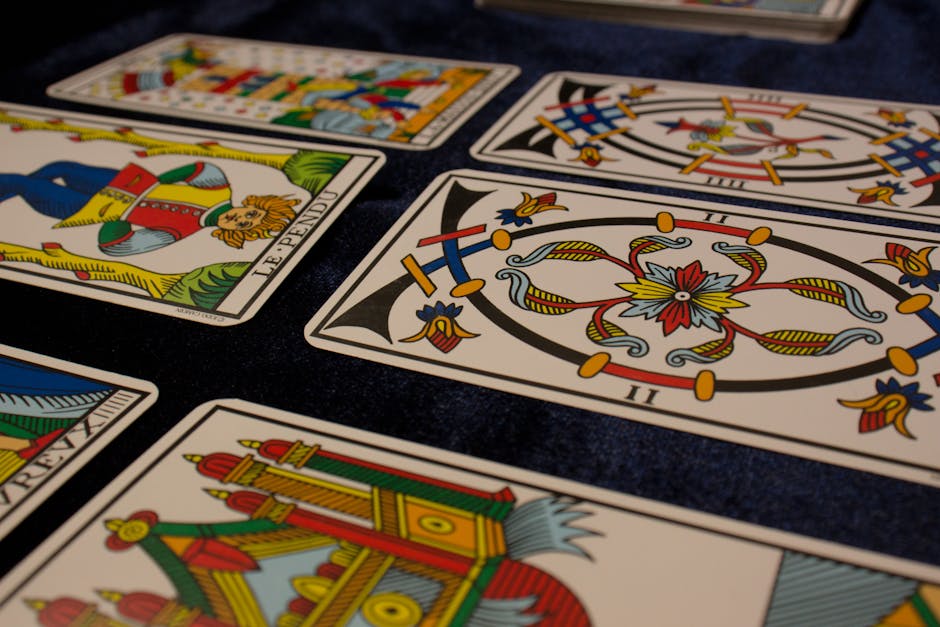
The Rider-Waite-Smith (RWS) deck, illustrated by Pamela Colman Smith and published in 1909, remains the gold standard for beginners. Here is why it matters: the RWS deck features fully illustrated scenes on every card, including the numbered suit cards (called pips). Many other deck traditions, like the Tarot de Marseille, show only patterned arrangements of cups or swords on the pip cards, which gives a new reader almost nothing to work with visually.
When you draw the Three of Swords in an RWS deck, you see a heart pierced by three swords against a grey, rainy sky. That image communicates heartbreak, grief, and painful truth without you needing to memorize anything. Compare that to a Marseille Three of Swords, which simply shows three crossed swords — the meaning is hidden behind convention rather than conveyed through imagery.
Nearly every tarot book and online resource references RWS imagery. Starting with this deck means every learning resource is immediately useful to you. Once you are comfortable with the system, branching out to other art styles — Thoth, Marseille, or any of the thousands of modern indie decks — becomes much easier because you already understand the underlying symbolic language.
When you get your deck, spend time simply looking through the cards before trying to read with them. Notice which images attract you and which ones make you uncomfortable. Separate the 22 Major Arcana from the 56 Minor Arcana and get familiar with the four suits: Wands (fire, action), Cups (water, emotion), Swords (air, thought), and Pentacles (earth, material world).
How to Shuffle and Draw Cards
There is no single correct way to shuffle tarot cards. The three most common methods are:
Overhand shuffle: Hold the deck in one hand and use the other to pull small packets of cards from the top or middle, dropping them back on top. This is the gentlest method and works well for larger cards.
Riffle shuffle: Split the deck in half and interleave the two halves together, the same way you would shuffle poker cards. Some readers avoid this because it can bend the cards, but it produces a thorough mix.
Messy pile shuffle: Spread all the cards face-down on a flat surface and swirl them around with both hands, then gather them back into a stack. This method is excellent for allowing reversals (upside-down cards) to enter the deck naturally.
Shuffle until you feel ready to stop. Some readers shuffle a set number of times (seven is common), while others shuffle until a card falls out (called a “jumper”) or until the deck feels right in their hands. There is no wrong approach.
To draw cards, you can cut the deck into three piles and restack them, fan the cards face-down and pull ones you are drawn to, or simply deal from the top. Consistency matters more than method — pick one approach and use it regularly so your practice develops a rhythm.
The One-Card Daily Pull
The single best habit for learning tarot is pulling one card each morning. This is your foundation practice, and it works like this:
Shuffle your deck while holding a simple question in mind: “What do I need to know about today?” or “What energy should I focus on?” Draw one card and place it face-up in front of you.
Spend at least sixty seconds looking at the image before reaching for any guidebook. Notice the figure’s posture, the colors, the background elements, and any objects they hold. Ask yourself: what feeling does this image give me? What situation in my life does it remind me of?
Then consult your guidebook or a reference for the traditional meaning. Compare your intuitive impression with the standard interpretation. Write both down in a notebook or your phone — the date, the card, your gut reaction, and the book meaning.
At the end of the day, revisit your card. Did it connect to anything that happened?
The Eight of Pentacles might have shown up on a day you spent focused on detailed, skill-building work. The Five of Cups might have appeared on a day when a disappointment overshadowed something good that was also present. These daily connections are how card meanings stop being abstract and start becoming personal.
💡 Pro Tip: Pull one card each morning as your foundation practice. At the end of the day, revisit it and note any connections to what happened. This builds personal card meanings faster than memorization.
The Three-Card Spread: Past, Present, Future
Once you have done daily pulls for a week or two, the three-card spread is your next step. Shuffle with a specific question or situation in mind. Draw three cards and lay them left to right:
Position 1 (Left) — Past: What events, decisions, or energies led to the current situation.
Position 2 (Center) — Present: The dominant energy or challenge you are facing right now.
Position 3 (Right) — Future: The likely outcome if the current trajectory continues.
The key to reading a three-card spread is not interpreting each card in isolation. The cards tell a story together. The past card sets the context, the present card identifies the core theme, and the future card shows where the energy is heading.
Look for connections — do the cards share a suit? Are there repeated numbers? Is there a progression from a difficult card to a more hopeful one, or vice versa?
Your First Reading: A Sample Walkthrough
Let us say you ask about a job situation that has been stressful. You draw three cards:
Past — Six of Wands: This card shows a figure on horseback receiving public recognition, with a laurel wreath on their wand. In the past position, this suggests you previously experienced a period of professional success or acknowledgment. You earned respect and things were going well.
Present — Ten of Wands: A figure struggles to carry ten heavy wands toward a town in the distance, bent under their weight. In the present position, this is clear: you are overburdened. The workload or the responsibility that came with that earlier success has become too much to carry alone.
Future — Two of Cups: Two figures face each other, exchanging cups in a gesture of mutual respect, with a caduceus and a lion’s head above them. In the future position, this card suggests that a partnership or collaborative relationship will be key to resolving the burden. The solution is not to carry more — it is to share the load with someone you trust.
Notice how the three cards create a narrative arc: success led to overwork, and the path forward involves partnership. That connected story is far more useful than reading each card as a standalone keyword. The Six of Wands alone says “victory.” The Ten of Wands alone says “burden.” But together, they say “your past victory created your present burden” — a much more specific and actionable insight.
Interpreting Cards in Context
The same card can mean very different things depending on the question and the position. The Four of Swords — a figure lying on a stone slab in a church with three swords on the wall and one beneath them — traditionally means rest, recovery, and retreat.
In a career reading, the Four of Swords might suggest you need a break or that the situation is currently in a holding pattern. In a relationship reading, it could point to emotional withdrawal or a needed period of space. In a health reading, it might literally refer to rest and recovery from illness. In a spiritual context, it could signal meditation or the need for mental quiet.
Context also comes from surrounding cards. The Four of Swords next to The Tower suggests forced rest after a crisis.
Next to The Star, it suggests healing rest that leads to renewal. Next to The Devil, it might indicate retreating from an unhealthy situation. Train yourself to read cards as part of a conversation with each other rather than as isolated data points.
⚠️ Important: Avoid asking yes/no questions. Instead of “Will I get the job?” ask “What do I need to know about this opportunity?” Open-ended questions produce layered, useful readings.
Building Intuition vs. Relying on Guidebooks
New readers worry about getting card meanings “wrong.” Here is the truth: the guidebook gives you the traditional symbolic framework, but your intuition gives you the specific application. Both are necessary.
In the first few months, lean on your guidebook. There is no shame in looking up every card during a reading — you are building vocabulary. But always pause to form your own impression before opening the book. Over time, you will notice that your initial reactions become more accurate and more specific than the generic book definitions.
A practical exercise for building intuition: pull a card, turn it face-up, and describe the scene out loud as if you are telling a story to someone who cannot see it. What is the character doing? Where are they?
What happened just before this moment? What is about to happen next? This narrative approach activates a different part of your thinking than keyword memorization and produces richer, more personalized interpretations.
Keep a tarot journal. Record every reading — the date, the question, the cards drawn, your interpretation, and later, what actually happened.
After three months, review your journal. You will see patterns in which cards tend to show up for which types of situations in your life. Those personal patterns become the backbone of your intuitive reading style.
Common Beginner Mistakes
Confusion about reversed cards. A reversed card (drawn upside-down) does not simply mean the opposite of its upright meaning. Reversals often indicate blocked energy, internalized qualities, delays, or the need to look inward. The Empress reversed is not “anti-abundance” — it may point to neglected self-care or creative energy that has not yet found its expression. Many beginners choose to read without reversals at first, and this is perfectly valid. Add them when you feel ready.
Asking yes/no questions. Tarot does not work well as a binary oracle. Instead of asking “Will I get the job?” ask “What do I need to know about this job opportunity?” or “What energy should I bring to my interview?” Open-ended questions produce layered, useful readings. Closed questions produce frustration when you try to extract a simple yes or no from the Nine of Pentacles.
Reading for yourself when emotionally charged. If you are desperate, heartbroken, or furious, your emotional state will color every interpretation. You will see what you want to see or what you fear, not what the cards are actually showing you. Wait until you can approach the reading with genuine curiosity rather than anxiety. If you cannot wait, ask a trusted reader to pull cards for you instead.
Doing too many readings on the same question. Pulling cards repeatedly because you did not like the first answer does not produce better guidance — it produces confusion. One reading per question. If the answer is unclear, sit with it for a day or two and see if clarity emerges from lived experience.
Over-relying on memorized keywords. Knowing that the Eight of Cups means “walking away” is useful, but staring at the card and noticing that the figure is leaving at night, under an eclipse, with the cups stacked imperfectly behind them — that tells you a much richer story about why they are leaving and what they are leaving behind. Let the imagery teach you. The pictures are there for a reason.
Moving Forward
Your first few readings will feel uncertain. You will second-guess yourself, fumble through your guidebook, and wonder if you are doing it right. That is the process working. Every experienced reader started exactly where you are now, staring at a spread of cards and thinking “I have no idea what this means.”
The path forward is simple: one card a day, a journal to track your observations, and patience with yourself as the language of the cards becomes your own. Tarot is a skill, not a gift. The more you practice, the more fluently you will read. Start with the Rider-Waite-Smith, start with one card, and let the conversation unfold from there.
References
- Wikipedia. “Tarot.”
- Biddy Tarot. “How to Read Tarot Cards.”
- Labyrinthos. “Learn Tarot.”